
What Do You Mean by SEO? A Beginner’s Guide That Actually Makes Sense
No jargon, no fluff. Just a clear explanation of what SEO is, why it matters, and how you can start using it today.
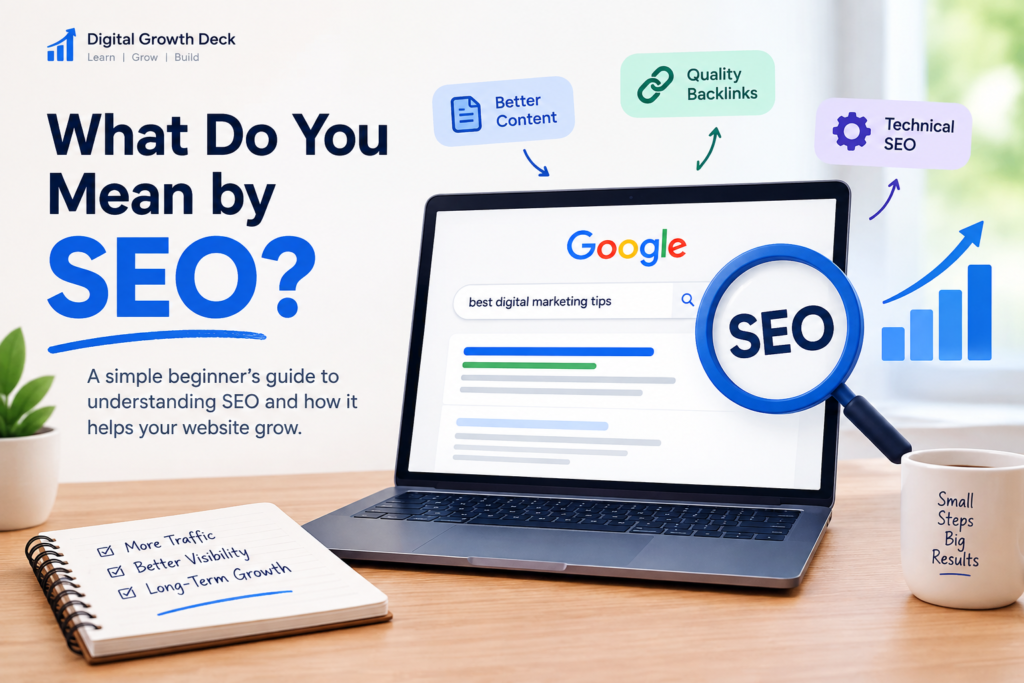
So, what do you mean by SEO?
SEO stands for Search Engine Optimization. It’s the practice of improving your website so search engines like Google can find it, understand it, and show it to people who are searching for exactly what you offer. Better SEO means more visitors, and those visitors arrive without you paying for every single click.
That’s the short answer. The rest of this guide covers what’s behind it, with real examples, common mistakes, and a simple plan you can follow even if you’re starting from zero.
Want more beginner-friendly guides like this? Explore our latest posts at https://digitalgrowthdeck.com/category/blogs/
Why Does SEO Feel So Confusing?
Let’s face it. When you search for “SEO” on Google, there are so many words to take in – backlinks, crawlers, canonical tags, domain authority, algorithm updates… It is overwhelming. If you have written some blogs and received no responses (no visitors, no comments, and not even a visit from your cousin) or if someone suggested you “do SEO,” but didn’t explain what it meant, does this sound like you?
I want to make sure we’re on the same page with regard to your progress. You aren’t “behind,” nor are you “bad” at SEO. Most of the people explaining how SEO works have forgotten what it was like to be clueless about SEO.
What Do You Mean by SEO in Digital Marketing?
The term “digital marketing” is an overarching category that includes many types of marketing such as social media, email campaigns, paid advertising, content creation, etc. SEO (search engine optimization) is the aspect of digital marketing that allows you to attract users to your website by using organic means to generate interest in your site, as opposed to paying for it.
Paid advertising is like having a sign in front of your store; it’s there for everyone to see and will be until you take it down. Search engine optimization (SEO) is more about making sure people can easily locate your business, that your store looks great inside and out, and that people who live near you are telling others about how much they enjoy coming to your store. While SEO does take longer to establish than paid advertising, once established, it continues to work long after the initial setup.
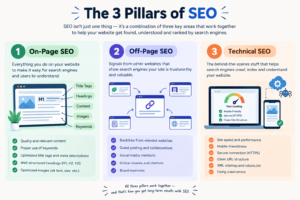
In digital marketing, SEO usually falls into three buckets:
- On-page SEO: what’s on your pages, such as content, headings, images, and keywords,etc.
- Off-page SEO: signals from outside your site, mainly backlinks (other websites linking to you).
- Technical SEO: how your site works behind the scenes, including speed, mobile-friendliness, and structure.
SEO vs Paid Ads: A Quick Comparison
Many beginners ask which one is “better.” Honestly, it depends on your goal and timeline. Here’s a side-by-side look:
| SEO | Paid Ads | |
|---|---|---|
| Speed of results | Slow (usually a few months) | Fast (often same day) |
| Cost per visitor | Low over time | You pay for every click |
| Longevity | Can keep working for years | Stops when the budget stops |
| Trust factor | High, since people see it as earned | Lower, since people know it’s an ad |
| Best for | Long-term growth, blogs, learners | Launches, quick offers, testing ideas |
Smart marketers often use both. But if you’re a learner or a small business with a limited budget, SEO is usually the smarter place to begin.
How Do Search Engines Actually Work?
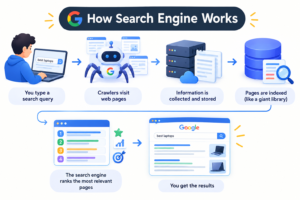
You don’t need to be an engineer to understand this part. Search engines do three things:
- Crawl: Automated bots visit web pages and follow links to discover new content.
- Index: The pages they find get stored in a giant database, a bit like a library catalog.
- Rank: When someone searches, the engine picks the most relevant, helpful pages from that catalog and orders them.
SEO is basically about making each of those three steps easier for your site. If bots can’t crawl your pages, they won’t be indexed. If they’re not indexed, they can’t rank. Simple as that.
What Do You Mean by Keywords?
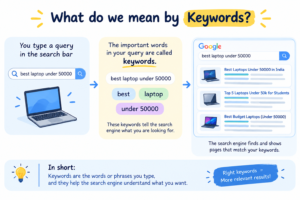
Keywords are the terms and expressions that people use when they enter queries into search engines. Examples of these keywords include “What does SEO stand for?” “What are some of the best AI tools available to marketers?” and “How do I create my own blog?”
Good keyword research is about hearing. What types of questions are your target audience asking? How do they specifically ask them? If your content answers those questions, search engines will have a reason to display your site.
An example of how this would look if you ran a fitness blog would be:
Too broad: “workout” (thousands of major websites are competing for this)
More Professional: “beginner home workout”
Even better: “15-minute home workout for beginners without equipment.
Long-tail keywords (the longer, more specific phrases) have less search volume; however, these terms are much easier to rank for, and the users that search them typically have a clear understanding of what they are looking for. These types of keywords can be extremely beneficial to new websites.
A few quick tips:
Using your primary keyword within the heading of your post, the first sentence of your post, and possibly even in a subheading will help to improve search engine rankings.
Add some of your target keywords into the content in a way that sounds natural to the reader (search engines refer to this as LSI or semantic keywords, such as “rankings in search engines”, “organic web traffic”, and “results from Google searches”).
Do not “stuff.” If a sentence sounds strange when read aloud, then rewrite the sentence.
What Do You Mean by an SEO-Friendly Website?
An SEO friendly web site is a site that can be used by both users and search engines with ease. In other words;
- It loads fast.
- It is effective for use in phone applications.
- No one will get lost with the clearly defined navigation.
- Each page includes a relevant title as well as a short description.
- Images possess alternative text (alt text).
- Content is relevant, has unique content, and can be easily understood.
- URLs are easy to read and understand (for example,/what-do-you-mean-by-seo, rather than /page?id=48291).
- It uses HTTPS; as such, your users will experience a safe connection.
Here’s a simple test. Ask a friend to open any page on your site for five seconds. If they can tell you what the page is about, you’re on the right track. If they look confused, search engines probably are too.
Where Digital Growth Deck Fits In?
Learning SEO shouldn’t feel like decoding a secret language. That’s why we built Digital Growth Deck.
We publish practical digital marketing blogs and honest information about digital marketing and AI tools, including plans and pricing, so you can choose what suits you instead of guessing. Our goal is simple: help you learn something you can use today, not just bookmark and forget.
What makes us different?
- Plain-language explanations. If we use a technical term, we explain it.
- Authentic information. We share what’s useful, not what’s hype.
- Learner-first content. Whether you’re a student, freelancer, or small business owner, we write with you in mind.
- Focus on AI tools. Marketing is changing quickly, and we help you keep up without the overwhelm.
What You Gain From Understanding SEO
Knowing the definition of SEO is step one. To apply SEO, this will make a difference:
With more traffic to your site (without having to pay per-click), you’ll be able to consistently rank well and therefore attract visitors on a regular basis.
There is a higher level of confidence. Sites that appear at the top of the search result pages are generally trusted.
SEO encourages you to write better content because it requires you to answer actual questions, so your writing will be clearer.
Clear decision-making. If there is a decrease in traffic, you will have a clear idea of how to correct the issue, as opposed to panicking.
The actual shift is not technical. It goes from hoping that others discover you to understanding the reason why they did.
How SEO Works: A Step-by-Step Breakdown
Step 1: Find out what people are searching for.
The first step is finding what people search for on Google. Use free search engines like Google Autocomplete, People also ask boxes, and/or a keyword search engine to find out what search terms your target market is searching for. When you begin to type in a subject on Google, pay attention to the auto–suggested options; these represent real searches being made by real people.
Step 2: Produce high-quality answers to your questions.
Do not only repeat information that is currently available; rather, provide new context, examples, and/or your individual thoughts regarding the content of this page. Think about whether or not people will leave this page with a complete understanding of the topic they are seeking answers to.
Step 3: Optimize the page.
Put your main keyword in the title, first 100 words, and a heading. Add a clear meta description, tidy URL, and image alt text.
Step 4: Make your site technically healthy.
Check that it loads quickly and works on mobile. A slow, clunky site loses visitors before they read a word. Google’s free PageSpeed Insights tool will show you what to fix.
Step 5: Link smartly.
Connect related pages on your own site (internal links) and, over time, earn links from other trusted sites. One link from a respected website is worth more than dozens from random ones.
Step 6: Track and improve.
Use Google Search Console and Google Analytics to see what’s working. Update old posts, fix what’s underperforming, repeat.
SEO isn’t a one-time task. It’s a habit. And the results build slowly, so give it a few months before judging.
7 Common SEO Mistakes Beginners Make
Everyone makes these. Knowing them early saves you months.
- Stuffing keywords everywhere. Repeating the same phrase in every sentence makes your writing awkward and can hurt your rankings.
- Ignoring search intent. If people searching “what is SEO” want a simple explanation, a sales page won’t satisfy them. Match what they actually want.
- Publishing thin content. A 200-word post that skims the surface rarely beats a thorough, helpful one.
- Forgetting mobile users. Most searches happen on phones. If your site is hard to use on a small screen, you’ll lose visitors fast.
- Skipping meta titles and descriptions. They’re your first impression in search results. Leaving them blank wastes a free chance to earn clicks.
- Buying cheap backlinks. Shortcuts like this can get your site penalized. Earn links with good content instead.
- Quitting too early. SEO is slow. Many people give up in month two, right before things start moving.
Which of these sounds like you? Don’t worry, all of them are fixable.
Your Quick-Start SEO Checklist
Want something you can act on right now? Here’s a simple checklist:
Pick one main keyword for your page
Add it to your title, first paragraph, and one heading
Write a meta description under 160 characters
Add alt text to every image
Check your site on your phone
Link to at least two related pages on your site
Submit your site to Google Search Console
Tick these off, and you’ve already done more than many websites out there.
Frequently Asked Questions
What do you mean by SEO in simple words?
SEO means making your website easier for search engines to understand, so it shows up when people search for topics you cover. More visibility usually means more visitors.
How long does SEO take to work?
Usually a few months, sometimes longer for competitive topics. Small wins, like a page climbing a few spots, can show up sooner. Patience really does pay off here.
Is SEO free?
You can do a lot of it for free by writing helpful content and following best practices. Paid tools and professional help can speed things up, but they’re not required to begin.
What’s the difference between SEO and paid ads?
Paid ads give you instant visibility, but they stop when your budget does. SEO takes longer to build, but the traffic can continue without paying per click.
Do I need to be technical to learn SEO?
Nope. Basic SEO is mostly about clear writing, understanding your audience, and keeping your site tidy. You can pick up the technical side gradually.
Ready to Learn SEO the Easy Way?
You now know what SEO means, how keywords fit in, what makes a website SEO-friendly, which mistakes to avoid, and how to start. That’s more than most people know when they begin.
The next step is small: pick one page on your site and improve its title, opening paragraph, and heading today. Then keep going.
For more simple, honest guides on SEO, digital marketing, and AI tools, visit Digital Growth Deck and start learning something new right now.
Explore:
- Digital Marketing Guides → https://digitalgrowthdeck.com/
- AI Tools Guides → https://digitalgrowthdeck.com/category/ai-tools/
- SEO Guides → https://digitalgrowthdeck.com/category/seo/